How It Works
How Live Online Classes Work at Family World School
See how live online classes for kids work at Family World School: small live groups, vetted educators, one flat fee, and real community for homeschool families.
How Live Online Classes Work at Family World School
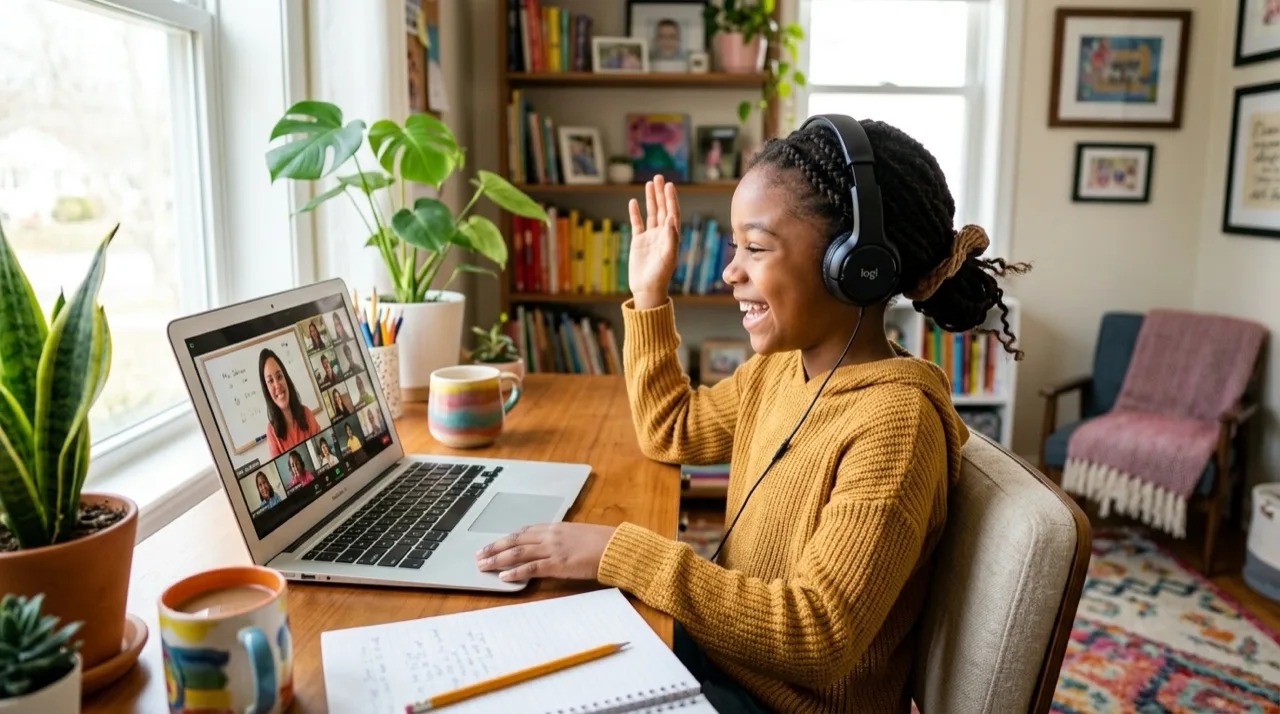
Picture a Tuesday morning. Your daughter logs in from the kitchen table, waves hello to seven classmates and a teacher who already knows her name, and spends the next forty-five minutes debating a story, solving a problem on a shared whiteboard, and laughing with kids who feel like friends. No commute. No lost-in-the-crowd anonymity. Just real teaching, in real time, from home. That is what live online classes for kids look like when they are done well, and it is the heart of how Family World School works.
If you are new to this world, the idea of "school on a screen" can sound either too rigid or too lonely. Live online classes are neither. They sit in the sweet spot between the freedom of homeschooling and the structure of a real classroom. This guide walks you through exactly how they work, what to expect week to week, and how to tell a good program from a forgettable one.
What "Live" Actually Means
The word that matters most here is live. A live online class is synchronous, meaning the teacher and students are together at the same scheduled time, usually over a video platform such as Zoom. This is very different from a pre-recorded video course where a child watches a lesson alone and clicks through quizzes.
In a live class, a certified or vetted teacher leads real-time instruction, asks questions, and adjusts on the spot when a student is confused (Source: Connections Academy). Children raise virtual hands, talk to each other, share their screens, and work through problems together. As one review of virtual learning research put it, the most effective sessions include shared audio and video for everyone, virtual hand-raising, small-group breakouts, and live chat (Source: Quality Matters). The screen is not a wall. It is a window into a room full of people.
This format is growing for a reason. Homeschooling is no longer a fringe choice. About 3.4 million students were homeschooled in the United States during the 2024-2025 school year, roughly 6.3 percent of the school-age population, and the sector is growing at nearly three times its pre-pandemic rate (Source: NHERI). Many of those families are not teaching everything at the kitchen table alone. They are turning to live classes and cooperatives to bring expert teaching and real friendship into the home.
A Typical Week in a Live Online Class
Every program is a little different, but most well-run live classes follow a rhythm that quickly becomes second nature.
The schedule
Classes meet on set days and times, the same way an in-person class would. A child might have a literature class on Monday and Wednesday mornings and a science class on Tuesday afternoons. Between sessions, students complete reading, practice, or short projects on their own time, which preserves the flexibility families love about homeschooling (Source: K12).
The class itself
A good live session is interactive from the first minute. Teachers open with a warm-up, move into discussion or direct teaching, break the group into smaller pods for collaborative work, and close with a check for understanding. Small-group discussions let kids bounce ideas off each other in real time, and collaborative projects build genuine teamwork (Source: Connections Academy).
Between classes
Learning does not stop when the call ends. Teachers grade assignments, give feedback, and stay reachable by message or email so students are never stuck for long (Source: Connections Academy). Parents get visibility into progress without having to become the subject-matter expert in every topic.
Why Class Size Is the Secret Ingredient
Here is something many parents do not realize until they have tried both: the number of children in a live class changes everything.
Research on virtual learning is clear that smaller is better for engagement. Classes built around heavy discussion need lower enrollment to keep cognitive load manageable, and studies find that small groups of three to five students strongly boost the sense of community that drives real learning (Source: Quality Matters). A child who is one of eight is seen, called on, and known. A child who is one of forty often drifts into the background and quietly checks out.
This is why the best live online classes for kids deliberately cap their group sizes. A small live class is not a budget version of a big one. It is the entire point. It is what makes the difference between a child performing for a camera and a child genuinely participating.
Does Online Learning Mean a Lonely Child?
This is the question almost every parent asks, and it is a fair one. The honest answer: only if the program is built badly.
Done right, live classes are one of the most social things a homeschooled child can do. Enrollment in a live online program helps children make friends and join activities they would not otherwise have access to (Source: Connections Academy). When the same small group meets week after week, students stop being strangers on a grid and start being a class, with inside jokes, study partners, and a teacher who notices when someone is having an off day.
The community angle matters more than ever, because families are actively seeking belonging, not just academics. Homeschool cooperatives, where families pool together for shared learning, served over 1.7 million children in 2024, and more than half of the fast-growing microschool movement operates on a cooperative model (Source: National Microschooling Center). Parents are not only chasing convenience. They are chasing connection.
How Family World School Helps
This is where Family World School was designed to be different. Family World School is a cooperative, not a marketplace. That distinction shapes everything about how our live classes work.
- Vetted educators, not a bidding pool. Every teacher is reviewed and trusted by the community before they ever lead a class. You are not gambling on an anonymous profile and a star rating. You are joining a class led by an educator the cooperative stands behind.
- One flat, transparent monthly fee. There are no surprise per-class charges or constantly changing prices. Families pay one clear price, which makes it easy to plan and removes the pressure of pricing every single subject. For context, families interested in microschools report a willingness to pay around 433 dollars a month (Source: National Microschooling Center), so transparent flat pricing is a meaningful advantage.
- Live classes built around small groups. Our classes are designed for real-time interaction and discussion, the kind of teaching the research says actually works.
- Real community and belonging. Family World School mainly serves African American and continental African families while remaining open to all, and it is built around shared values and a sense of home. The goal is not just to deliver lessons. It is to give your child a community that feels like family.
In short, the cooperative model means everyone is rowing in the same direction: teachers, families, and the community together, rather than buyers and sellers in a transaction.
How to Evaluate Any Live Online Program
Whether you choose Family World School or look elsewhere, use this short checklist when comparing live online classes for kids:
- Is it truly live and interactive, or just recorded videos with a "live" label?
- How small are the classes? Smaller groups mean more attention and more engagement.
- Who teaches, and how are they vetted? Look for a clear, trustworthy process.
- Is the pricing transparent? Flat, predictable fees beat a pile of add-ons.
- Is there real community, or just isolated lessons? Belonging keeps children motivated.
If a program scores well on all five, your child is far more likely to thrive.
The Takeaway
Live online classes for kids work by bringing the best parts of a real classroom, a present teacher, classmates, discussion, and accountability, into the flexibility and safety of home. The magic is not the technology. It is small live groups, trusted teachers, and a genuine sense of belonging. When those three things come together, screen time stops being passive and starts being one of the richest parts of a child's week.
Family World School was built around exactly that promise: live classes, vetted educators, one honest price, and a community that treats your child like one of its own. If that sounds like the home you have been looking for, explore our programs or book a quick consult, and come see what a live class feels like from the inside. You are warmly invited to join the community.
Sources: NHERI; Connections Academy; K12; Quality Matters; National Microschooling Center via OpenEd / homeschool reporting, 2024-2025.