Guides
Online Classes for Homeschoolers: What to Look For
A practical 2026 guide to online classes for homeschoolers: how to judge teachers, class size, live vs. recorded, cost, and community before you enroll.
Online Classes for Homeschoolers: What to Look For
You decided to homeschool, and you quickly realized one thing: you cannot teach everything yourself. Chemistry labs, conversational Spanish, essay feedback, a teacher who actually loves teaching algebra. That is where online classes for homeschoolers come in, and it is also where the choices get overwhelming fast. Free co-ops, big course catalogs, recorded video libraries, full-time virtual academies. They all promise the world. Some deliver, and some quietly leave your child clicking through slides alone.
This guide walks through exactly what to look for so you can tell the difference before you pay or commit your child's school year.
Why so many families are turning to online classes
Homeschooling is no longer a fringe choice. There were an estimated 3.4 million K-12 homeschool students in the United States during the 2024-2025 school year, about 6.3 percent of the school-age population, and the movement is still growing at roughly 4.9 percent a year, nearly three times the pre-pandemic rate (Source: National Home Education Research Institute). In fact, 36 percent of reporting states recorded their highest homeschool enrollment ever, surpassing even pandemic peaks (Source: Johns Hopkins Institute for Education Policy).
The growth is also more diverse than many people assume. The share of Black households homeschooling jumped from about 3.3 percent at the start of 2020 to 16.1 percent by that fall, the largest increase of any group, and many of those families have stayed (Source: ABC News). Parents cite a desire for curriculum control, cultural representation, safety, and a more nurturing learning environment (Source: TIME). For all of these families, online classes have become the practical engine that makes homeschooling work day to day.
The takeaway: you are not alone, and the market has matured enough that you can afford to be selective.
Live, recorded, or both?
The first real decision is format. Each has a place.
Live online classes
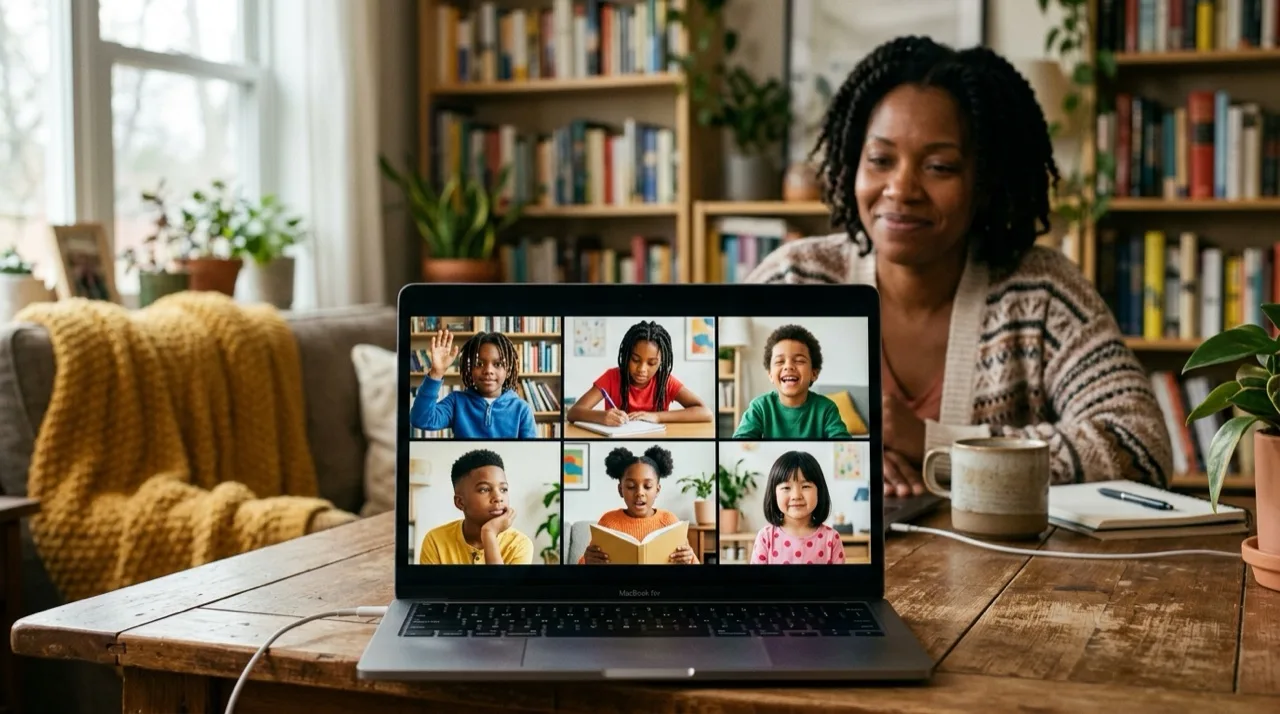
Live classes meet on a set schedule, usually on Zoom or a similar platform, with a teacher and a small group of peers. The best ones are genuinely interactive, with discussion, questions, and students getting to know each other in the chat (Source: Schoolhouse Online). This is the closest thing to a real classroom, and it adds accountability, a rhythm to the week, and human connection.
What to look for: a regular schedule, a teacher who responds in real time, and a replay or recording so your family stays on track if you miss a session. Strong programs include replays as standard (Source: Schoolhouse Online).
Recorded or self-paced classes
Self-paced classes let your child work whenever it suits your family. They are flexible and often cheaper, which is wonderful for travel, irregular schedules, or independent older students. The risk is isolation and drift. Without a live teacher or check-ins, a self-motivated teen may thrive while a younger or struggling learner stalls.
A practical rule: use live classes for subjects that benefit from discussion and feedback, such as writing, languages, and science, and consider self-paced options for skill drills or supplementary material.
How to judge the teacher
In homeschooling, no U.S. state requires online instructors to hold a specific certification, so the burden is on you to ask good questions (Source: National Home Education Research Institute). A polished website tells you very little about who actually stands in front of your child each week.
Ask directly:
- What is the teacher's background and experience teaching online learners specifically?
- How are educators screened and vetted before they teach?
- How often will my child interact directly with the teacher, and how is feedback given?
- Can I see a sample lesson, a syllabus, or a recorded class?
The ability to demonstrate regular, meaningful teacher-student interaction is one of the clearest signals of quality, and the inability to do so is a genuine red flag (Source: Dwight Global).
Class size matters more than the catalog
A program boasting hundreds of courses can still disappoint if every class is packed. Smaller groups make it far easier for a teacher to spot where your child is stuck, run frequent check-ins, and tailor instruction to the individual rather than the average (Source: Lydian Academy). In oversized online rooms, learning tends to become generic and aimed at the middle of the group.
Before enrolling, ask for the typical and maximum class size. A specific, confident answer is a good sign. Vagueness is not.
Accreditation: helpful, but not the whole story
Many parents assume they need an "accredited" program. Here is the honest picture. No U.S. state requires a homeschool curriculum, program, or diploma to be accredited, and technically a curriculum cannot be accredited at all, only institutions can (Source: The HomeSchoolMom). Accreditation can still be useful as a quality-assurance signal, and it may matter if your child plans to transfer to a traditional school or wants a recognized transcript for certain colleges.
So treat accreditation as one input, not a deal-breaker either way. If a provider claims it, ask which body grants it and whether that body covers distance education. Watch for probationary accreditation status, which is a quieter warning sign (Source: Dwight Global).
Community and belonging
Academics are only half the reason families choose live online learning. The other half is connection. The strongest programs build in clubs, community time, and ways for both kids and parents to feel supported, not just course content delivered into a void (Source: Schoolhouse Online). Homeschooling families have long formed co-ops precisely so their children can learn together and build friendships (Source: TIME). Online classes should extend that, not replace it with screens and silence.
Ask whether there is any community beyond the class itself, and whether other parents are reachable. A child who feels they belong shows up engaged.
Cost and the fine print
Online options range from free, donation-based volunteer co-ops to full paid academies with extensive support (Source: Virtual Homeschool Group). More expensive is not automatically better, and free is not automatically lesser. What matters is transparency.
Watch for:
- Per-class fees that quietly stack up across several subjects
- Registration, material, or technology fees added on top
- Confusing tier systems where the useful features sit behind the top price
- Refund and withdrawal policies, in case a class is not the right fit
Add up the true yearly total per child before comparing, not the headline monthly number.
How Family World School helps
This is exactly the gap Family World School was built to close. We are a values-driven online homeschool cooperative, not a marketplace, which means we are community-owned rather than a directory of strangers competing for clicks. Every educator is vetted, classes are live and interactive, and families pay one flat, transparent monthly fee instead of stacking per-class charges. Because we are a cooperative, real community and belonging are built in, with a particular heart for African American and continental African families while staying open to all. You get the structure of a school, the warmth of a co-op, and pricing you can actually plan around.
Your quick checklist
Before you enroll in any online class for homeschoolers, confirm:
- Format fits your child (live, self-paced, or a deliberate mix)
- The teacher's experience and vetting are clear, with a sample available
- Class sizes are small enough for real attention
- Pricing is transparent, with no surprise fees
- There is genuine community, not just content
- Any accreditation claims check out, if accreditation matters to you
Choosing well is not about finding the biggest catalog. It is about finding real teachers, real attention, and real belonging for your child.
Ready to see what that looks like in practice? Explore the live programs at Family World School, or book a quick consult to talk through the right fit for your family and join a community that is homeschooling together.